Restaurant Website Design in 2027: 10 Features Every Restaurant Needs to Grow
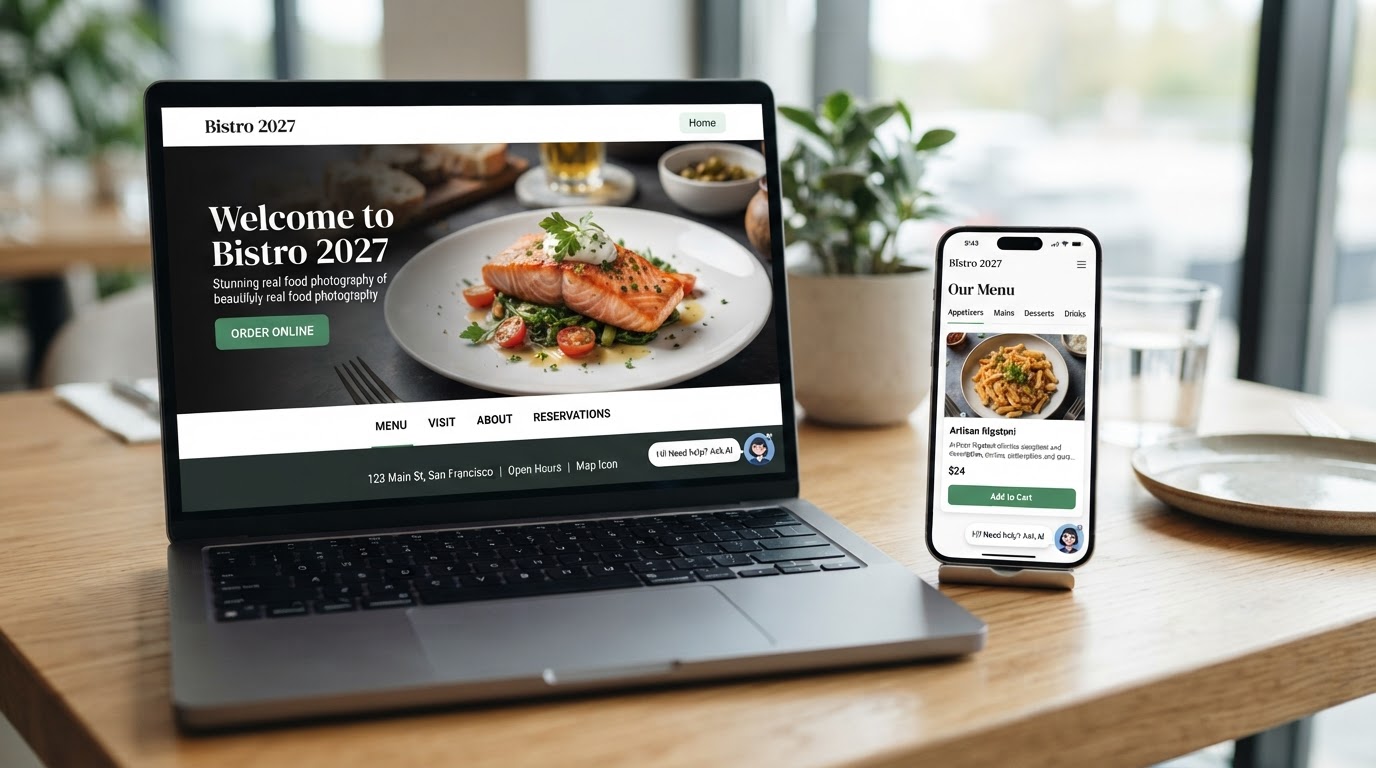
Many restaurant owners invest in a website because they know they need one. They pick a layout, add their menu, upload a few photos, and assume the website is done.
But in 2027, a beautiful restaurant website is no longer enough.
Customers expect to find your restaurant on Google, understand your menu, ask a quick question, place an order, or make a reservation without friction. Search engines and AI tools expect clear, accurate, well-structured information. And as a business owner, you should expect your website to do more than sit there — it should help you grow.
A restaurant website should do more than look professional. It should help customers discover the restaurant, find information, ask questions, order food, make reservations, and become repeat customers.
Let's walk through the restaurant website design features that actually matter in 2027 — and why each one helps your restaurant grow.
1. A Modern, Professional Website Design
First impressions happen fast. When someone lands on your restaurant website, they form an opinion within seconds.
An outdated website can create a poor first impression before a customer ever reads your menu. Broken layouts, tiny text, mismatched fonts, and confusing navigation can all make a restaurant look less professional than it is.
A modern restaurant website should use clean layouts, readable typography, consistent branding, clear navigation, and an intuitive mobile experience. Every page should feel like it belongs to the same business.
But professional design only matters when it works alongside functionality. A website can look beautiful and still fail if customers can't find the menu, place an order, or contact the restaurant.
Good design makes the right action obvious. Great design makes it effortless.
2. Fully Optimized Local SEO
A beautiful website that nobody can find has limited value. That's why local SEO is one of the most important features of a restaurant website.
Restaurant owners need to target relevant local keywords so search engines understand what the restaurant serves and where it is located.
For example, a restaurant in Huntington Beach might naturally target searches like:
- Pizza restaurant in Huntington Beach
- Best sports bar in Huntington Beach
- Greek restaurant near me
- Restaurants with outdoor seating in Orange County
The correct keywords depend on the restaurant's actual location, menu, and services. Don't create pages for cities where the restaurant doesn't operate.
Unique Title Tags and Meta Descriptions
Each important page should have a unique, descriptive SEO title and meta description.
For example:
Greek Restaurant in Huntington Beach | Restaurant Name
The meta description should accurately summarize the page and encourage relevant visitors to click. A meta description doesn't directly guarantee higher rankings, but it can help explain the page in search results.
Restaurant Name and Location in Headings
Every main page should have a clear H1 heading that explains what the page is about, supported by relevant H2 and H3 headings.
For example:
H1: Greek Restaurant in Huntington Beach, CA
Supporting H2 headings might include:
- Explore Our Authentic Greek Menu
- Visit Our Huntington Beach Restaurant
- Frequently Asked Questions
Headings should accurately describe the restaurant rather than simply repeat keywords.
Search-Friendly Menu Pages
Your menu should be easy for customers to read and easy for search engines to understand. An HTML menu with clear categories, descriptions, and prices is generally preferable to a PDF because it can be updated easily and integrated into your website's pages.
Internal Linking
Pages on your website should link to each other where it makes sense. Your homepage should link to your menu, your contact page, and your ordering or reservation options. Blog posts should link to relevant service and menu pages.
Internal links help customers navigate and help search engines understand the relationship between pages.
Local Keyword Research and Google Business Profile
Local keyword research helps you understand what customers in your area are actually searching for. Pairing that with a well-maintained Google Business Profile — with accurate hours, address, photos, and categories — helps search engines understand your restaurant's location, food, and relevance to local searches.
Search Engine Indexing and Mobile Performance
Your website should be crawlable so search engines can discover and index your pages. Mobile performance matters because most customers look up restaurants on their phones. A slow or broken mobile experience can limit how effectively your website performs.
Restaurant Structured Data
Appropriate restaurant structured data can help search engines understand details like your name, address, hours, and menu. For a foundational overview of how search engines discover and interpret websites, Google's SEO Starter Guide is a useful reference.
SEO helps search engines understand the restaurant's location, food, services, and relevance to local searches. No provider can promise specific Google rankings, but a well-optimized website gives your restaurant a stronger foundation.
3. Authentic Restaurant Photography
People eat with their eyes first. Authentic photography of your food, interior, dining areas, and atmosphere helps customers understand what to expect before they visit.
Real photographs build trust. When a customer sees actual dishes from your kitchen, your actual patio, and your actual dining room, they feel more confident about choosing your restaurant.
Generic stock photography that doesn't represent the actual restaurant can have the opposite effect. It can make a restaurant feel impersonal or misleading.
Images should be properly sized, use descriptive alt text, and be optimized for performance so they load quickly on mobile devices. Large, unoptimized images can slow down your website and frustrate visitors.
Use real photos of your real restaurant. Customers can tell the difference.
4. An AI-Powered Website Chat Widget
Not every customer wants to call a restaurant. Some just want a quick answer.
A restaurant website should allow customers to ask questions directly without needing to pick up the phone. An AI-powered chat agent can help with that.
An AI-powered chat agent can:
- Answer questions about restaurant hours.
- Explain menu items.
- Answer questions about ingredients and dietary options using verified restaurant information.
- Provide reservation information.
- Help with group dining inquiries.
- Capture customer contact information when appropriate.
- Route complex questions to restaurant staff.
- Provide answers outside normal business hours.
This can reduce repetitive questions for employees and help restaurants respond to potential customers who would otherwise have to call or move on.
AI should only provide accurate, approved information. When a question falls outside what the system can answer confidently, it should escalate the question to restaurant staff rather than guess.
Real Client Example: Perry's Pizza
To illustrate why this matters, here's a real example from Sales Spike's work with Perry's Pizza in Huntington Beach, California.
A visitor contacted Perry's Pizza through its website chat widget asking about hosting a party for more than 20 people and whether the restaurant could offer a discount.
This kind of interaction matters because it represents a potentially valuable group dining inquiry. A customer considering a large party order is exactly the type of opportunity a restaurant doesn't want to miss.
The chat widget created a direct communication opportunity for that inquiry. Instead of the visitor having to call during business hours or send an email and wait, they could start the conversation right from the website.
We're sharing this as a paraphrase rather than an exact quotation, and we're not claiming that the party booked, that a discount was provided, or that specific revenue was generated — those outcomes have not been verified.
The point is simpler: a restaurant website should create opportunities for customers to communicate with the business, especially when they are considering large group orders or events.
A chat widget — whether AI-assisted or staff-monitored — gives those customers a place to start.
5. SEO-Friendly Restaurant Blog Posts
Your homepage can't realistically answer every question someone might ask about your restaurant. That's where blog posts come in.
Restaurants can publish relevant content that answers customer questions and supports local search visibility. For example:
- Best places to watch football in Huntington Beach
- Where to host a birthday dinner in Huntington Beach
- Best pizza for large parties
- Restaurant happy hour specials
- Local dining guides
Blog posts can support relevant keywords, create internal links to your menu and service pages, and help your restaurant earn long-term organic discovery for questions your homepage doesn't cover.
The emphasis should be on useful, original content. Publishing articles simply to increase word count or to repeat slight variations of the same keyword is not a strong long-term strategy.
Each post should answer a real customer question and provide genuine value.
What a 2027 Restaurant Website Includes
6. Clear Menus, Online Ordering, and Reservations
A restaurant website should make important actions easy to find. Customers shouldn't have to search through multiple pages to find basic information.
A well-designed restaurant website should include:
- Mobile-friendly menus.
- Clear online ordering buttons.
- Reservation links.
- Click-to-call functionality.
- Directions to the restaurant.
- Updated hours.
- Accessible menu information.
If a customer has to hunt for your menu, your hours, or your phone number, you're creating friction. Friction is what makes potential customers leave and choose another restaurant.
The most important actions — order, reserve, call, get directions — should be visible and easy to tap on every device.
7. Google Reviews and Reputation Integration
Restaurant websites benefit from displaying genuine customer reviews. Authentic Google reviews help potential customers evaluate a restaurant before deciding to visit.
When someone is comparing two nearby restaurants, recent, honest feedback can make one business feel more trustworthy than the other.
The challenge for most restaurants isn't getting a review here or there — it's asking consistently. Automated review requests help restaurants ask every customer for feedback without relying on employees to remember.
Google identifies review count and positive ratings as factors that can contribute to local ranking prominence. That makes a steady flow of authentic reviews valuable for both reputation and visibility.
Avoid review gating — the practice of selectively asking only happy customers for reviews — and never promise five-star reviews. The goal is authentic feedback from real customers.
At Sales Spike, we help restaurants get more Google reviews through automated, personalized review requests and follow-ups.
8. Mobile Speed and Technical Performance
Restaurant websites must work properly on smartphones. Many customers look up restaurants while traveling, deciding where to eat, or getting ready to place an order — often on their phones.
A technically sound restaurant website should include:
- Responsive design that adapts to any screen.
- Fast loading pages.
- Optimized images.
- Easy-to-use navigation.
- Clear mobile calls to action.
- Accessibility for all users.
- Crawlable page content.
- Proper search engine indexing.
A visually attractive website with poor technical performance can limit its effectiveness. Slow pages, broken mobile layouts, and unoptimized images frustrate customers and can undermine the work you've put into design and SEO.
For official guidance on performance signals, see Google's Core Web Vitals guidance.
9. Websites Built for Google and AI Search
Restaurant discovery is evolving. People still use traditional search engines, but more are also using AI-powered tools like Google AI Overviews and ChatGPT to research where to eat.
Clear, structured, accurate website content can make restaurant information easier for both search and AI systems to interpret.
This includes:
- Accurate business information.
- Relevant FAQs that answer real customer questions.
- Descriptive menu pages.
- Structured data where appropriate.
- Clear location information.
- Consistent business details across your website and online profiles.
- Original, useful content.
None of this guarantees that ChatGPT or any other AI tool will recommend your restaurant. AI systems use different information sources and retrieval methods, and their answers can change.
But a website that clearly and accurately answers customer questions gives both people and automated systems better information to work with.
10. A Complete Restaurant Growth System
Here's the most important point: a website alone is only one part of growing a restaurant.
A beautiful website that doesn't connect to reviews, customer communication, or reactivation is a digital brochure. It might look great, but it won't do much to recover missed opportunities or bring customers back.
Sales Spike helps connect multiple marketing and communication systems so they work together. Those systems include:
- Custom restaurant website design.
- Local SEO optimization.
- Restaurant blog content.
- Automated Google review requests.
- Missed-call text-back automation.
- SMS marketing to bring customers back on slow days.
- AI-powered customer communication where enabled.
- Customer lead capture and follow-up.
These tools work together to help restaurants attract customers, communicate with them, and encourage repeat visits.
Not every optional feature is automatically included in every package. The core $249/month offer includes a custom restaurant website, missed-call text-back, Google review automation, and customer reactivation through text marketing.
The goal isn't to sell you a website. It's to help your restaurant make more money by recovering missed opportunities, bringing back existing customers, improving your online presence, and automating repetitive marketing tasks.
Your Restaurant Doesn't Just Need a Better Website. It Needs a Better System.
Restaurant owners should stop thinking of their website as a standalone digital brochure.
Your website should be connected to a larger system that supports customer discovery, communication, reviews, and retention. When those pieces work together, your website stops being an expense and starts being a growth engine.
Sales Spike is a restaurant-focused provider helping businesses bring these systems together — not a general digital marketing agency or a lead generation service.
If your website looks good but isn't helping you bring customers back, recover missed calls, or generate reviews, it may be time to look at the system around it.
See How Sales Spike Can Help Grow Your Restaurant
Want to see how everything works together? Visit our contact page, fill out the short form, and watch a video where we walk you through a real client's account and show you exactly how our restaurant growth system works.
See How It WorksFrequently Asked Questions About Restaurant Website Design in 2027
What should a restaurant website include in 2027?
A restaurant website in 2027 should include a modern, mobile-friendly design, clear menus, online ordering or reservation links, local SEO, real food photography, an easy way for customers to ask questions, Google review integration, and clear calls to action.
How much does a restaurant website cost?
Pricing varies by provider, functionality, and management services. Sales Spike includes a custom-built and managed restaurant website in its $249/month marketing package, with no setup fee and no long-term contract. Messaging and phone usage are billed separately.
How can restaurants improve their local SEO?
Restaurants can improve local SEO by using clear page titles and meta descriptions, relevant headings, accurate business information, an HTML menu, descriptive image alt text, internal links, a well-maintained Google Business Profile, and authentic Google reviews. Local SEO helps search engines understand the restaurant's relevance, but it does not guarantee specific rankings.
Do restaurants need an AI chatbot on their website?
Not every restaurant needs an AI chatbot, but every restaurant website should give customers a way to ask questions without calling. An AI-powered chat agent can answer common questions using approved restaurant information and route complex questions to staff. It should only provide accurate, approved answers.
How do Google reviews help restaurant websites?
Authentic Google reviews help potential customers evaluate a restaurant and can contribute to local search visibility. Automated review requests help restaurants consistently ask customers for feedback, but businesses should avoid review gating and never promise five-star reviews.
Can restaurant blog posts help with local SEO?
Yes. Useful, original blog posts can answer specific customer questions, target relevant local searches, and create internal links to menu and service pages. Blog content should be genuinely helpful rather than published only to increase word count.
How can a restaurant website generate more customers?
A restaurant website generates more customers when it is easy to find, easy to use on mobile, clear about what the restaurant offers, and designed to guide visitors toward ordering, reserving, or visiting. Connecting the website to reviews, text marketing, and missed-call text-back creates a system that turns visitors into repeat customers.
Keep Reading
Why Your Restaurant Needs a Custom Website (And How It Can Bring in More Customers)
October 19, 2026
Why Are People Visiting My Restaurant Website but Not Ordering Food?
October 14, 2026

How Can My Restaurant Show Up on ChatGPT and Google AI in 2027?
November 2, 2026
Want to learn more? Read about custom restaurant website design, discover how to get more Google reviews, or explore our restaurant marketing automation services.