Why Are People Visiting My Restaurant Website but Not Ordering Food?
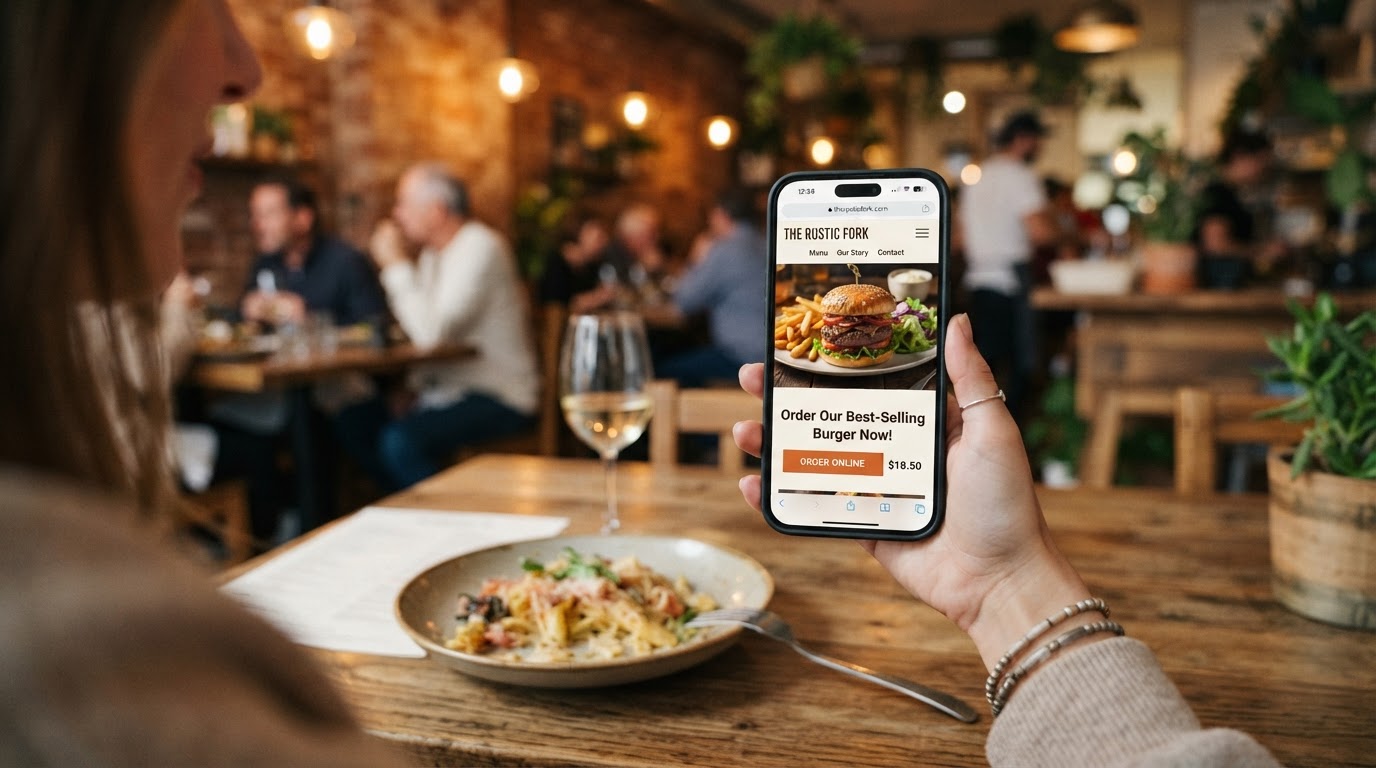
Your restaurant website could be the best-looking website in your entire city.
It could have beautiful colors, professional photography, animations, and a design that looks like it cost thousands of dollars.
But here's my question.
Is it actually helping your restaurant get customers?
Because if nobody can find your restaurant on Google, your menu is difficult to navigate, or customers can't figure out how to place an order, then I don't care how pretty your website looks.
It's not doing its job.
At Sales Spike, I build restaurant websites with two main goals: help potential customers discover the restaurant and make it easier for those customers to choose it.
A restaurant online ordering website shouldn't just be something you have because every other business has one.
It should be a tool that supports your restaurant's marketing.
Let's break down what could be going wrong with your website and what you can do to improve it.
1. Your Restaurant Website Looks Good, but Nobody Can Find It
This is one of the biggest problems I see.
A restaurant owner pays someone to build a beautiful website. The website launches, everything looks professional, and the owner thinks the job is finished.
But when someone searches Google for restaurants in the area, the website is nowhere to be found.
That's a problem.
Think about how customers choose restaurants.
They might search:
- Pizza restaurant in Huntington Beach
- Best Greek food near me
- Sports bar showing UFC fights
- Italian restaurant with online ordering
- Restaurant catering near me
If your website doesn't clearly communicate what your restaurant offers and where it's located, you're making it harder for search engines to understand your business.
That doesn't mean adding a city name to your homepage will magically put you at the top of Google.
But it does mean your website needs to be built with search visibility in mind.
How I Build Restaurant Websites for Search Engines
When I build a website through Sales Spike, I focus on the technical foundation.
That includes:
- Connecting the website to Google Search Console
- Creating and submitting an XML sitemap
- Using appropriate H1, H2, and H3 headings
- Writing descriptive page titles and meta descriptions
- Adding relevant structured data, including restaurant schema where appropriate
- Building useful FAQ sections
- Creating keyword-focused blog content
- Including the restaurant's name, location, and relevant services naturally throughout the website
- Making sure important pages can be discovered and indexed
For example, if I'm building a website for a restaurant in Huntington Beach, I want Google to understand the restaurant's name, location, cuisine, and services.
The homepage should establish that information clearly.
I also want the website to answer the kinds of questions customers actually ask.
Search engines and AI platforms use different systems to discover, retrieve, and present information, but clear, accessible, accurate website content is valuable for both.
The goal is to give your restaurant a stronger foundation for being discovered—not to promise a specific ranking.
2. Your Homepage Isn't Convincing People to Eat at Your Restaurant
Let's say someone actually finds your website.
Now what?
The first page they're likely to see is your homepage.
And in my opinion, that's the most important page on your entire website.
Why?
Because the homepage needs to convince someone that your restaurant is worth visiting.
Imagine a customer comparing two restaurants.
One website has a plain background, a couple of sentences, and a hard-to-find menu.
The other website has professional photos of its food, pictures of the atmosphere, recent customer reviews, and a big button that says "Order Online."
Which one makes it easier for the customer to decide?
Your homepage should immediately answer a few questions:
What kind of food do you serve?
Show the food.
What does the restaurant look and feel like?
Show the atmosphere.
Why should someone trust your restaurant?
Show authentic customer reviews. Displaying recent Google reviews directly on the homepage is one of the most effective ways to build trust.
How can someone order or visit?
Make the next step obvious.
I don't want customers to have to search around your website to figure out what to do.
I want the homepage to make that decision easy.
What Every Restaurant Homepage Should Include
At a minimum, I recommend a homepage with high-quality food photography, clear restaurant branding, visible ordering or reservation buttons, easy access to the menu, contact information, and authentic recent Google reviews.
The exact design will depend on the restaurant.
A pizza shop, sports bar, Greek restaurant, and fine-dining restaurant shouldn't necessarily have identical websites.
But they should all make it easy for customers to understand the experience and take action.
3. Your Restaurant Menu Is a PDF or an Image
This is something I pay particular attention to when building restaurant websites.
Your menu should be built directly into the website using HTML whenever possible.
Not just a PDF.
Not just a picture of the menu.
An actual website menu with readable text, organized categories, and a mobile-friendly layout.
Here's why.
Customers Shouldn't Have to Zoom In to Read Your Menu
Think about someone opening your website on their phone.
If your menu is a giant image, they might have to pinch and zoom just to read the prices or ingredients.
If it's a PDF, they might have to open another document, scroll sideways, or download a file.
That's unnecessary friction.
Instead, customers should be able to scroll through your menu just like any other part of your website.
Pizza.
Wings.
Sandwiches.
Appetizers.
Whatever your restaurant serves, the information should be easy to find.
Search Engines Can Better Understand Text-Based Menus
An HTML menu also gives search engines directly accessible text about your food.
If you sell specialty pizzas, sandwiches, or catering packages, those items can appear as readable content on the website.
That creates opportunities to describe what you actually offer.
A PDF isn't automatically invisible to Google, and Google can process some image content. But a well-structured HTML menu is generally easier to navigate, maintain, and integrate with the rest of the website.
For restaurants, that's a better long-term foundation.
4. Your Online Ordering Buttons Are Difficult to Find
Let's say a customer lands on your homepage and decides they want to order.
What happens next?
Do they immediately see an "Order Online" button?
Or do they have to click through three different pages?
If a customer wants to order food, don't make them work for it.
I believe restaurant websites should have clear calls to action throughout the customer journey.
That could include:
- Order Online
- View Menu
- Make a Reservation
- Call Now
- Get Directions
Not every restaurant needs every button.
A pickup-only pizza shop will have different needs from a restaurant that primarily accepts reservations.
But the actions that matter should be obvious.
I also make sure those buttons actually work.
A beautiful ordering button that leads to a broken page is worse than having a simple, functional website.
Your customers shouldn't have to figure out how to give you their money.
5. Your Restaurant Website Isn't Mobile-Friendly
Mobile optimization is one of the three most important things I focus on when building a restaurant website.
Think about how people look for restaurants.
They're out with friends.
They're deciding what to eat for dinner.
They're searching for a nearby restaurant while they're out.
A lot of those searches happen on phones.
People aren't necessarily sitting at a laptop comparing restaurant websites.
That's why I believe a restaurant mobile-friendly website should be designed for mobile first.
What Does a Mobile-Friendly Restaurant Website Look Like?
A customer should be able to open your website and immediately use it.
The food photos should display correctly.
The text should be readable.
The menu should be easy to scroll.
The ordering button should be easy to tap.
The website shouldn't take forever to load.
And the customer shouldn't have to zoom in or scroll sideways just to find information.
Mobile optimization isn't just about shrinking a desktop website until it fits on a smaller screen.
It's about making the entire experience convenient for someone using a phone.
If customers have trouble navigating your website, some may leave before ordering.
6. You're Not Showing Customers Your Google Reviews
Google reviews are extremely important when someone is deciding where to eat.
Think about it.
If you're comparing two restaurants, you're probably going to look at what other customers are saying.
That's why I like displaying recent Google reviews directly on restaurant homepages.
When a potential customer lands on your website, they should be able to see authentic feedback from people who have actually eaten there.
It's another reason to trust the restaurant.
Why I Prefer Recent Reviews
A restaurant might have hundreds of reviews, but customers also want to know what the experience is like today.
Recent feedback can help show that the restaurant is still serving customers and delivering a good experience.
I recommend using a review display that stays current rather than manually placing the same testimonials on the homepage forever.
The reviews should be genuine and accurately represented. A review widget should not mislead visitors by implying that selected five-star reviews represent every customer's experience.
And there's another important part of this.
You should have a consistent system for asking customers to leave reviews.
That way, your reputation-building efforts don't depend entirely on employees remembering to ask.
7. You Think a New Website Will Automatically Bring More Orders
This is where I think a lot of restaurant owners get confused.
A new website doesn't automatically mean more orders.
You can build the best website in your city.
But if nobody visits it, how is it supposed to generate sales?
You need people to discover your restaurant.
That might happen through Google Search, Google Maps, online advertising, social media, referrals, or customers who already know your business.
The website then needs to make it easy for those visitors to order, reserve, call, or visit.
Getting traffic and converting traffic are two different jobs.
Search engine optimization can help you attract relevant visitors.
Advertising can put your restaurant in front of people searching for particular foods or services.
And a functional website can help those visitors take the next step.
All three can work together.
That's why I don't tell restaurant owners that simply launching a new website guarantees more customers.
It doesn't.
You need a strategy for getting people there.
8. You're Not Doing Ongoing Restaurant SEO
When I build a restaurant website, I don't believe the SEO work should stop the day the website launches.
In fact, that's just the beginning.
I've seen Google rankings improve after optimizing restaurant websites, and I've also seen some increases in website traffic.
But those results don't mean every restaurant will experience the same growth.
Search visibility takes ongoing work.
Two areas I believe restaurants should consistently focus on are SEO blog posts and quality backlinks.
Publish Useful Restaurant Blog Posts
Blog posts give your website opportunities to answer more specific customer searches.
For example, a restaurant might publish articles about:
- Its most popular menu items
- Catering services in its area
- Local dining occasions
- Food options for groups or families
- Restaurant events and specials
- Common customer questions
The key is to create useful content that genuinely relates to the restaurant.
Don't publish dozens of nearly identical articles with different city names just to stuff keywords into the website.
Write content that helps potential customers make a decision.
Earn Relevant Backlinks
Backlinks are links from other websites pointing to yours.
They can help search engines discover your website and may contribute to its authority.
For restaurants, useful opportunities can include local publications, community organizations, event partners, and relevant business directories.
The goal should be earning legitimate links from trustworthy, relevant websites—not buying spammy links or participating in link schemes.
Neither blog posts nor backlinks guarantee higher rankings.
But consistent, quality SEO work gives a restaurant more opportunities to improve its visibility over time.
9. You're Ignoring Google and AI Search
More customers are using AI tools to research businesses, including restaurants.
Someone might ask ChatGPT for restaurant suggestions in a particular city or search for a restaurant that meets specific needs.
That creates another reason to make sure your restaurant's online information is accurate and accessible.
When I build restaurant websites through Sales Spike, I pay attention to both traditional search engines and AI-powered search experiences.
That means having clear website content, useful FAQs, accurate business information, readable menus, and appropriate structured data.
However, there's an important distinction.
No website developer can guarantee that ChatGPT will recommend a particular restaurant.
AI platforms have their own systems for retrieving information and generating responses.
What I can do is build a website with a strong technical and content foundation so the restaurant is easier for these systems to understand and discover.
That's the approach I take.
10. Your Website Doesn't Have to Look Completely Different
Sometimes I speak with restaurant owners who already love their current website.
They like the colors.
They like the layout.
They like the overall design.
That's completely fine.
At Sales Spike, I generally prefer rebuilding the website using my own process so I can control the structure, functionality, mobile experience, and SEO implementation.
But that doesn't mean I need to completely change how it looks.
If an owner wants to keep the same design, I can recreate that appearance while making improvements behind the scenes.
The goal isn't to force every restaurant into the same template.
It's to make sure the website looks the way the owner wants while meeting the technical and usability standards I build around.
11. Your Website Is Only One Part of Your Restaurant's Marketing
Here's the biggest thing I want restaurant owners to understand.
A website is important.
But a website alone isn't everything.
Imagine you have a great website that's properly optimized for Google.
That's good.
But what happens after customers visit your restaurant?
Are you collecting their contact information with permission so you can invite them back?
Are you consistently asking customers for Google reviews?
What happens when someone calls your restaurant and nobody answers? A missed-call text-back system can help.
These are all connected problems.
And I believe every restaurant should have basic systems in place to address them.
The Four Systems I Offer Through Sales Spike
1. A restaurant website built for visibility and conversions
I build and manage websites designed to showcase the restaurant, support SEO, and make it easy for customers to order, call, or visit.
2. A system to bring customers back on slow days
I help restaurants collect customer contact information with appropriate marketing consent and send targeted text promotions that encourage previous customers to return.
3. Automated Google review requests
Instead of relying entirely on employees to remember, restaurants can use automated follow-up messages to invite customers to leave honest Google reviews.
4. Automated missed-call text-back
When someone calls and nobody answers, the system can automatically send a helpful text with an ordering link, reservation link, or callback information.
These systems support different parts of the customer journey.
Your website helps customers learn about the restaurant.
Your review system helps build trust.
Your customer retention system gives previous customers a reason to return.
And missed-call text-back helps when your employees are too busy to answer the phone.
That's what I believe restaurant marketing should look like: simple systems working together.
Frequently Asked Questions
Why isn't my restaurant website getting online orders?
Possible reasons include insufficient website traffic, unclear ordering buttons, difficult navigation, slow loading times, mobile usability problems, or an ordering process that creates unnecessary friction. Start by checking whether visitors can easily find your menu and complete an order.
Does a new restaurant website automatically increase sales?
No. A new website can improve usability and help support search visibility, but sales also depend on traffic, customer demand, pricing, reputation, and the ordering experience.
How can I improve my restaurant website's Google ranking?
Start with accessible website content, accurate business information, relevant page titles, proper headings, an XML sitemap, mobile optimization, and useful local content. Consistent SEO work and legitimate backlinks can also help.
Can my restaurant website show up in ChatGPT searches?
It may be discoverable through AI-powered search experiences, depending on how those systems retrieve and evaluate information. Accurate, accessible website content can support discoverability, but there is no guaranteed method for appearing in ChatGPT recommendations.
Should my restaurant menu be a PDF or HTML?
An HTML menu is generally preferable for mobile usability, accessibility, and integration with website content. A downloadable PDF can still be offered as an additional option.
How important are Google reviews on a restaurant website?
Authentic Google reviews can help potential customers evaluate your restaurant. Displaying recent, accurately represented reviews on the homepage can provide useful social proof.
Should I rebuild my restaurant website or improve the existing one?
It depends on the website's condition and the owner's goals. Some websites can be improved without a rebuild. At Sales Spike, I typically rebuild restaurant websites to implement my preferred design, SEO, and functionality standards, while preserving the existing look if the owner wants it.
How much does Sales Spike cost?
Sales Spike's core restaurant marketing package costs $249 per month and includes restaurant website services, Google review automation, customer retention marketing, and missed-call text-back.
Final Thoughts: Your Restaurant Website Needs to Do More Than Look Good
If you're a restaurant owner, I want you to think about something.
Your website might look amazing.
But can customers find it?
Can they easily read your menu?
Can they place an order without getting frustrated?
Can they see what other customers are saying about your restaurant?
And once those customers visit, do you have a system to bring them back?
Those are the questions that matter to me.
I don't build restaurant websites just to make them look pretty.
I build them to give restaurants a stronger online foundation, make the customer experience easier, and support the marketing systems that help restaurants grow.
And for $249 per month, Sales Spike includes the website alongside the other essential systems I believe restaurants should have.
If you want to see what that looks like for your restaurant, visit Sales Spike.
See How Sales Spike Works
Get a restaurant website built for visibility and conversions, bring customers back on slow days, get more Google reviews, and recover missed calls — all for $249 per month.
Keep Reading
What Should a Restaurant Website Do Besides Display the Menu?
May 25, 2026
How Much Does a Restaurant Website Cost?
September 10, 2026
Do I Really Need a Website for My Restaurant?
September 12, 2026
Want to see all of these systems working together? Read about the 3 most important marketing systems every restaurant needs, or visit our Sales Spike pricing page to see what's included for $249 per month.