Why Your Restaurant Needs a Custom Website (And How It Can Bring in More Customers)
Think about the last time you wanted to try a new restaurant.
Chances are, you pulled out your phone and searched Google for something like "pizza near me," "best burgers in my area," or "Greek restaurant near me."
Maybe you even asked ChatGPT for restaurant recommendations.
Now think about this from a restaurant owner's perspective.
What happens if your restaurant isn't easy to find online?
What happens if someone discovers your restaurant, clicks on your website, and sees an outdated design, confusing menu, or an online ordering button they can't find?
They might leave and choose another restaurant.
That's why your restaurant's website matters.
It's not just a place to display your menu.
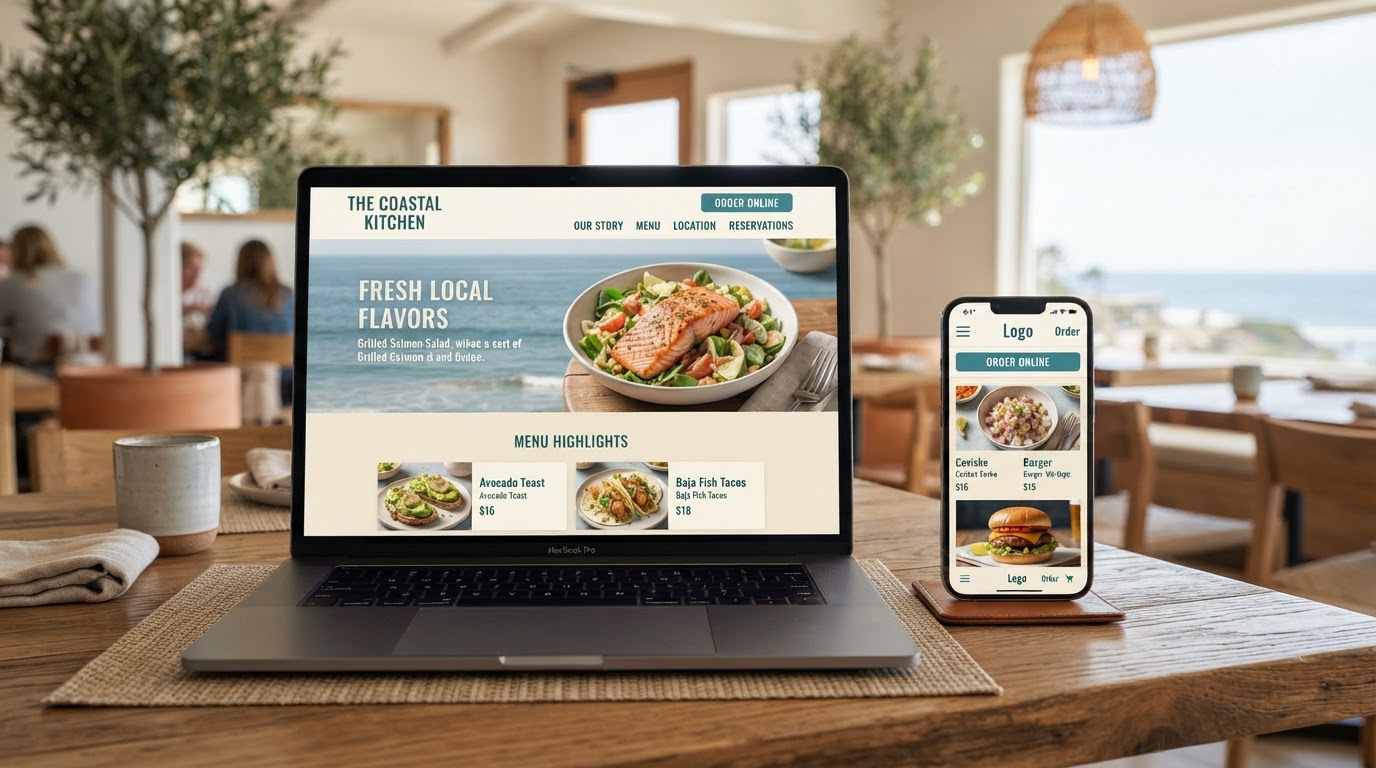
It's an opportunity to introduce your restaurant to new customers, showcase what makes your business special, and make it easy for people to order, call, or visit.
And the good news?
A professionally built restaurant website doesn't necessarily require thousands of dollars in upfront development costs anymore.
Let's break down what makes a great custom restaurant website, why SEO matters, and what restaurant owners should look for before hiring a website company.
1. Why an Outdated Restaurant Website Can Cost You Customers
Many restaurant websites haven't been meaningfully updated in years.
Some have outdated designs.
Others are difficult to navigate on mobile devices.
And many aren't properly structured to help search engines understand what the restaurant offers.
Imagine someone searching for a pizza restaurant in your city.
They find two options.
The first restaurant has a modern website with clear food photography, an easy-to-read menu, visible business information, and a prominent online ordering button.
The second restaurant has an outdated website with broken links, confusing navigation, and a menu that's difficult to read.
Which website makes ordering easier?
Even if both restaurants serve excellent food, the website experience can influence whether someone chooses to order.
Your restaurant website is often part of a customer's first impression of your business.
And if that experience is frustrating, you may be giving potential customers a reason to look elsewhere.
2. What Is Custom Restaurant Website Design?
Custom restaurant website design means building a website around the specific restaurant rather than simply inserting its name and logo into a generic layout.
Every restaurant has something different that makes it special.
Maybe it's the pizza.
Maybe it's the outdoor patio.
Maybe it's the atmosphere during a big football game.
Or maybe it's the dining experience, cocktails, or family recipes.
A custom restaurant website should showcase those strengths.
For example, a sports bar might feature its TVs, outdoor patio, and game-day atmosphere in the homepage hero section.
A pizza restaurant might lead with professional food photography and an easy-to-find ordering button.
A fine-dining restaurant might emphasize the ambiance, dining room, and reservation experience.
The goal isn't to make every restaurant website look the same.
The goal is to make the website feel like the restaurant itself.
What Should a Custom Restaurant Website Include?
A well-designed restaurant website should typically include:
- A homepage showcasing the restaurant's strongest selling points.
- Real food and restaurant photography.
- The restaurant's logo, colors, and branding.
- A mobile-friendly menu.
- Easy access to online ordering or reservations.
- Clear phone numbers, hours, and directions.
- Customer reviews or testimonials where appropriate.
- A contact page.
- Helpful FAQ sections.
- Search engine optimization.
- Fast loading speeds.
- Clear calls to action.
The exact pages and features should depend on the restaurant's business model.
A takeout-focused pizza shop may prioritize ordering.
A full-service restaurant may prioritize reservations.
A sports bar may highlight its events and atmosphere.
Custom design makes those differences possible.
3. Why Restaurant Website SEO Is So Important
A beautiful website is valuable.
But a beautiful website that nobody can find has limited marketing value.
That's where search engine optimization, or SEO, comes in.
Restaurant website SEO involves making your website easier for search engines to discover, understand, and potentially show in relevant search results.
For example, imagine you own a Greek restaurant in Huntington Beach.
You want your website to clearly communicate:
- Your restaurant's name.
- Your location.
- The type of food you serve.
- Your menu.
- Your hours.
- Your ordering or reservation options.
- What makes your restaurant worth visiting.
Search engines use many signals to understand websites and decide which results are relevant. For a foundational overview of how that process works, Google's SEO Starter Guide is a useful reference.
A well-structured restaurant website can support that process.
Proper H1 and H2 Headings
Every important page should have a clear primary heading.
For example:
H1: Greek Restaurant in Huntington Beach, CA
Supporting H2 headings might include:
H2: Explore Our Authentic Greek Menu
H2: Visit Our Huntington Beach Restaurant
H2: Frequently Asked Questions
These headings help organize the page for customers and search engines.
They should accurately describe the restaurant rather than simply repeat keywords.
SEO Titles and Meta Descriptions
Each important page should have a unique, descriptive SEO title.
For example:
Greek Restaurant in Huntington Beach | Restaurant Name
The meta description should accurately summarize the page and encourage relevant visitors to click.
A meta description doesn't directly guarantee higher rankings, but it can help explain the page in search results.
Location-Specific Keywords
Restaurants should use relevant local search terms naturally.
For example:
- Pizza restaurant in Huntington Beach.
- Greek food in Orange County.
- Sports bar in Huntington Beach.
- Pizza catering near me.
- Restaurant with outdoor patio in Huntington Beach.
The correct keywords depend on the restaurant's actual location, menu, and services.
Don't create misleading pages for cities where the restaurant doesn't operate.
The goal is to help search engines understand the restaurant's genuine local relevance.
4. How Restaurant Websites Can Become More Discoverable in AI Search
More people are using AI tools, including ChatGPT, to explore restaurant options and ask questions about local businesses.
That creates another reason for restaurants to keep their online information accurate, accessible, and well organized.
However, appearing in AI-generated recommendations is not guaranteed.
AI systems use different information sources and retrieval methods, and their answers can change.
How Can Restaurants Improve Their AI Search Readiness?
A good starting point is to make sure the website clearly answers questions people might ask.
For example:
- Does this restaurant offer gluten-free pizza?
- Does this sports bar show major sporting events?
- Does the restaurant have an outdoor patio?
- Does this restaurant offer catering?
- Can I order online?
- Where is the restaurant located?
- What are its hours?
When those answers are clearly available on the website, both customers and systems that can access the content have better information to work with.
Why FAQ Sections Matter
FAQ sections help restaurants answer common customer questions directly.
For example:
Does your restaurant offer catering?
Do you have outdoor seating?
Can customers order online?
Do you offer vegetarian options?
Where can customers park?
FAQs are useful because they provide clear information in natural language.
They may also help search engines understand relevant page content.
But adding FAQs alone doesn't guarantee higher Google rankings or mentions in ChatGPT.
The questions should be relevant, accurate, and useful to actual customers.
5. Why Restaurant Blog Posts Can Help With Local SEO
Many restaurant websites only have a homepage, menu, and contact page.
Those pages are important, but some restaurants may benefit from additional content addressing relevant customer searches.
For example, a pizza restaurant might publish useful articles about:
- Pizza catering for local events.
- Family pizza nights.
- Ordering pizza for an office lunch.
- Available gluten-free options.
- What makes its signature pizzas different.
A sports bar might publish articles about:
- Watching sporting events at the restaurant.
- Private parties and group dining.
- Outdoor patio dining.
- Its food and drink offerings.
These articles can help answer more specific questions that potential customers are searching for.
Local Keywords Should Be Relevant
A restaurant in Huntington Beach might naturally discuss Huntington Beach and nearby areas it genuinely serves.
But publishing dozens of nearly identical articles with different city names isn't a strong long-term content strategy.
Each article should provide useful, original information.
The goal is to build a website that answers real customer questions, not simply fill it with keywords.
What a Strong Custom Restaurant Website Includes
6. Your Restaurant Website Should Make It Easy for Customers to Take Action
Getting someone to your website is only part of the job.
Once they're there, you want to make the next step easy.
That's why calls to action matter.
A call to action, or CTA, is a button or link that helps visitors do something useful.
For restaurants, common CTAs include:
- Order Online.
- View Menu.
- Call Now.
- Get Directions.
- Make a Reservation.
- Contact Us.
A good restaurant website shouldn't make customers hunt for these buttons.
They should be easy to find throughout the website.
Why a Sticky Mobile Action Bar Helps
One useful feature is a sticky action bar at the bottom of the mobile screen.
As customers scroll, important actions remain accessible.
For example:
Illustrative example of a mobile sticky action bar.
This can make the mobile experience more convenient, particularly for customers who want to take action quickly.
The bar should be designed carefully so it doesn't cover important content or interfere with accessibility.
Why a Chat Widget Can Be Useful
A website chat widget gives visitors another way to ask questions.
For example:
"Do you offer catering?"
"Do you have outdoor seating?"
"Can I make a reservation?"
"Do you have gluten-free options?"
A chat widget can help visitors reach the restaurant or access information without searching through multiple pages.
However, it should provide accurate answers and make it clear when a customer needs to contact a staff member.
A restaurant website should make the next step obvious without pressuring visitors.
7. Why Mobile-Friendly Restaurant Websites Are Essential
Many customers look up restaurants on their phones.
They may be searching while traveling, deciding where to eat, or getting ready to place an order.
If the website doesn't work properly on mobile, the experience becomes frustrating.
Common problems include:
- Tiny text.
- Menus that require excessive zooming.
- Buttons that are difficult to tap.
- Images that don't display correctly.
- Slow-loading pages.
- Navigation that doesn't work.
- Ordering links that are hard to find.
A mobile-friendly restaurant website should make essential information accessible immediately.
Customers should be able to find the menu, hours, phone number, location, and ordering options without unnecessary steps.
Website Loading Speed Matters Too
Large images, unnecessary scripts, and poorly optimized pages can slow down a website.
That can frustrate customers and affect the overall experience. For official guidance on performance signals, see Google's Core Web Vitals guidance.
Website performance is also part of Google's page experience considerations.
Restaurants should focus on:
- Properly sized images.
- Modern image formats.
- Efficient page code.
- Responsive layouts.
- Avoiding unnecessary animations.
- Testing performance on real mobile devices.
A website should look professional, but it also needs to load quickly and work reliably.
8. Custom Restaurant Websites vs. Cookie-Cutter Website Templates
Some large website providers offer standardized restaurant website designs.
Templates aren't automatically bad.
They can be an affordable and practical starting point for some restaurants.
However, restaurant owners should understand the trade-offs.
A highly standardized design may offer less flexibility to highlight what makes their restaurant unique.
For example, a restaurant with a large outdoor patio may want a homepage focused on its atmosphere.
A takeout restaurant may need online ordering to be the most prominent feature.
A catering-focused restaurant may need dedicated catering pages and inquiry forms.
A custom website can prioritize those specific needs.
| Consideration | Cookie-Cutter Template | Custom Website |
|---|---|---|
| Reflects restaurant identity | Limited | Yes |
| Highlights unique strengths | Difficult | Yes |
| Prioritizes key actions | Fixed layout | Flexible |
| Upfront cost | Often lower | Varies by provider |
| Ongoing flexibility | Limited | Greater |
A balanced comparison. Templates can be a practical starting point; custom design offers more flexibility.
What Makes Sales Spike's Approach Different?
Sales Spike focuses on building websites around each restaurant. That includes building restaurant website pages around:
- Custom homepage hero sections.
- Restaurant-specific food and atmosphere photography.
- Matching colors, logos, and branding.
- Menu and online ordering accessibility.
- Search-friendly page structure.
- Relevant FAQ sections.
- Restaurant-specific blog content.
- Mobile-friendly calls to action.
- Website speed and usability.
The goal is to build a website that reflects the business rather than simply reuse the same presentation for every restaurant.
9. Why Ongoing Restaurant Website Management Matters
A restaurant website isn't something that should be forgotten after launch.
Menus change.
Business hours change.
Restaurants introduce new dishes.
Special events come and go.
And owners may want to update photography, promotions, or page content.
If a website company builds the site and leaves the owner to handle every update, maintaining it can become another responsibility.
That's why ongoing website management is valuable.
What Does Sales Spike Manage?
Sales Spike builds and manages restaurant websites.
When a restaurant owner needs reasonable changes to their existing website, they can request updates.
Examples include:
- Updating menu information.
- Changing restaurant hours.
- Adding new photos.
- Updating promotional content.
- Adjusting existing pages.
- Fixing website issues.
- Updating relevant restaurant information.
Major redesigns or complete website rebuilds are separate projects.
The goal is to make website ownership easier for restaurant operators who would rather focus on running their restaurants.
10. How Much Does a Custom Restaurant Website Cost?
Restaurant owners sometimes assume that getting a professional website means paying thousands of dollars upfront.
Traditional custom website development can involve substantial initial costs.
However, modern website-building technology, including AI-assisted development tools, can reduce the time required for some design and development tasks.
That can make professionally managed websites more accessible to smaller businesses.
The important thing is to evaluate the finished website and the services included, rather than assuming that AI-generated automatically means high quality.
A restaurant website still needs accurate content, working functionality, accessibility, search optimization, and ongoing maintenance.
Sales Spike's $249/Month Restaurant Marketing Package
Sales Spike offers its complete restaurant marketing system for $249 per month.
That includes:
Custom Restaurant Website
A professionally designed website built around the restaurant's branding, food, and customer experience.
Website Management
Reasonable ongoing changes and updates to the existing website.
Customer Text Marketing
Tools for building an opted-in customer list and bringing customers back through text message campaigns.
Google Review Automation
Tools that help restaurants get more Google reviews through authentic customer review requests.
Missed-Call Text-Back
Automatic follow-up messages for qualifying missed calls, with online ordering links and optional staff notifications. See how restaurant missed-call text-back works.
Initial Setup
The initial setup for the package is included without an additional setup fee.
There are no long-term contracts.
Text messaging and phone usage are billed separately, typically adding an estimated $20–$50 per month depending on actual usage.
That means the total monthly cost may be approximately $269–$299 for restaurants within that estimated usage range.
Actual charges depend on usage.
Instead of treating the website as an isolated expense, the package combines website management with other tools designed to support restaurant marketing and customer communication.
Custom Restaurant Website + Complete Marketing System
$249/month
No setup fee. No long-term contract. Messaging and phone usage billed separately.
See How Sales Spike Works11. How to Choose the Right Restaurant Website Design Company
Before hiring someone to build your restaurant's website, take a look at their previous work.
Don't just ask whether they can build a website.
Ask to see websites they've already built for real restaurants.
Then evaluate the experience yourself.
Look at Their Previous Restaurant Websites
Do the websites look customized?
Or does every restaurant have nearly the same layout?
Do the colors, photography, and overall design reflect each restaurant's identity?
Check the Mobile Experience
Open the websites on your phone.
Can you find the menu?
Can you order online?
Can you call the restaurant?
Are the buttons easy to use?
Review Their SEO Fundamentals
Look at whether the websites have:
- Clear page titles.
- Relevant H1 and H2 headings.
- Useful location information.
- Descriptive page content.
- Working internal links.
- Relevant FAQ sections.
- Fast loading speeds.
- Logical navigation.
These are useful indicators of SEO implementation, although they don't prove how well a website ranks.
Ask About Ongoing Updates
Who updates the menu when prices change?
Who adds new photos?
Who fixes broken links?
Who handles changes to existing pages?
Understanding what's included after launch is just as important as the initial design.
Ask About Pricing and Contracts
Find out:
- What the initial setup costs.
- What the monthly fee includes.
- Whether updates cost extra.
- Whether there is a long-term contract.
- Whether there are usage-based charges.
- What happens to the website and its content if you cancel.
A website provider should be transparent about these details.
Frequently Asked Questions About Custom Restaurant Websites
Do restaurants need a custom website?
Not every restaurant needs a fully custom website, but a custom design can help showcase its unique branding, food, atmosphere, and ordering experience.
How much does a restaurant website cost?
Pricing varies by provider, functionality, design requirements, and management services. Sales Spike includes a custom-built and managed restaurant website in its $249/month marketing package, with messaging and phone usage billed separately.
Can a restaurant website help improve Google rankings?
A well-optimized website can improve search engines' ability to discover and understand restaurant information. Actual rankings depend on many factors, including relevance, competition, location, and the restaurant's broader online presence.
Can restaurant websites show up in ChatGPT recommendations?
Restaurant information may appear in AI-generated recommendations, depending on the system and available sources. Clear, accurate, accessible website content can help make restaurant information easier to understand, but no website provider can guarantee inclusion.
What should a restaurant website include?
Most restaurant websites should include a menu, hours, location, contact information, mobile-friendly design, relevant ordering or reservation options, and clear calls to action.
Are FAQ sections good for restaurant SEO?
Relevant FAQ sections can help answer customer questions and clarify website content. They don't guarantee higher rankings or special search appearances.
Should restaurants have blog posts?
Useful blog posts can help restaurants provide information about their food, services, events, and local relevance. Content should be original, accurate, and written for actual customer needs.
Does Sales Spike manage restaurant websites after launch?
Yes. Sales Spike handles reasonable updates and changes to existing client websites. Major redesigns or complete rebuilds are separate projects.
Does Sales Spike charge a website setup fee?
The initial setup is included in Sales Spike's $249/month restaurant marketing package, with no additional setup fee.
Is there a long-term contract?
Sales Spike's standard offer has no long-term contract. Restaurant owners should review the applicable service terms for cancellation and website arrangements.
Final Thoughts: Your Restaurant Deserves a Website That Works for Your Business
If your restaurant is still using an outdated website, it may be time for an upgrade.
You don't necessarily need to spend thousands of dollars upfront.
Modern development tools, including AI-assisted website building, have made it possible to create and manage professional restaurant websites more efficiently.
But the most important thing isn't the technology used to build the website.
It's what the finished website does for your restaurant.
Does it showcase your food?
Does it reflect your atmosphere?
Can customers find your menu?
Can they order online?
Can they easily call or get directions?
Is the website structured to help Google and other search systems understand your restaurant? For official guidance on managing the business information customers see, review Google Business Profile guidance.
Your restaurant website should make it easier for people to discover your business and become customers.
And with Sales Spike, you can get a custom-built, fully managed restaurant website as part of a complete $249/month restaurant marketing package.
No big upfront setup fee.
No long-term contract.
Just a website designed around your restaurant, with ongoing management and additional tools to help you stay connected with customers.
Ready to Upgrade Your Restaurant Website?
See how Sales Spike can build and manage a custom website for your restaurant while helping you improve your online presence and customer communication.
See How Sales Spike WorksKeep Reading
Why Are People Visiting My Restaurant Website but Not Ordering Food?
October 14, 2026
How Much Does a Restaurant Website Cost?
September 10, 2026
How to Get More Google Reviews for Your Restaurant Without Asking Every Customer
October 19, 2026
Want to see how this fits the bigger picture? Read about AI for restaurants, explore our restaurant website services, or check out Sales Spike pricing to see the full $249/month package.