How to Get Better Google Reviews for My Restaurant?
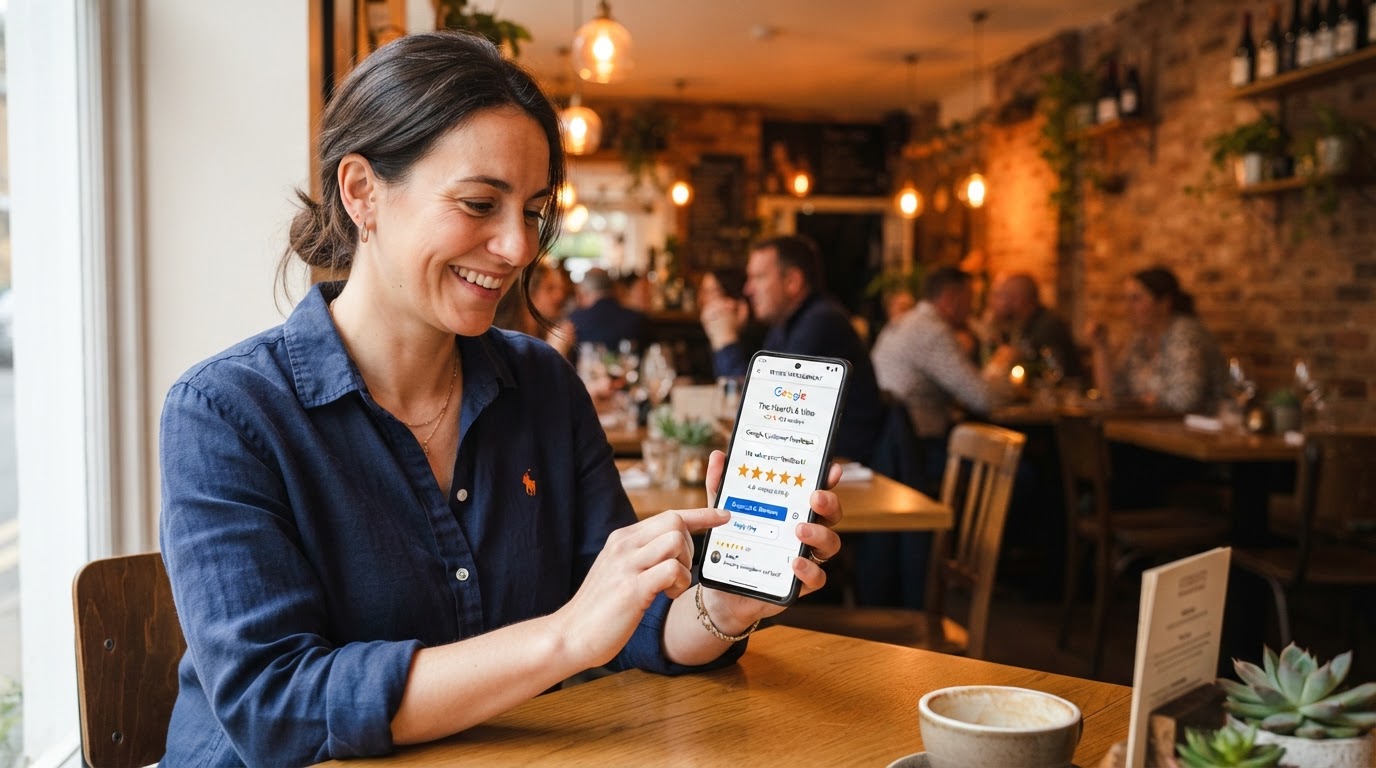
A lot of restaurant owners ask me the same question:
“How do I get better Google reviews for my restaurant?”
The first thing most owners think is that they just need to ask more customers for reviews. So they print a QR code, stick it on the table, and hope for the best.
That can generate some reviews. But I think there's a better, longer-term approach.
Getting more Google reviews shouldn't begin with begging customers for reviews. It should begin by building a customer list you own and creating a repeatable follow-up system.
The goal is a system where a customer visits, is given a reason to join your list, provides their first name and phone number with proper consent, and then receives a separate review request after the visit. If they don't engage, automation follows up when appropriate. And you keep owning that customer relationship.
Quick Answer
The best way to consistently get more Google reviews is to create a repeatable customer follow-up system. Collect customer information with permission through an in-store QR code, website form, or another opt-in method. Then send a separate, personalized review request several hours after the visit or the following day. If the customer doesn't engage, automation can send limited follow-ups. Never provide discounts or free items in exchange for a review.
Why Google Reviews Matter So Much for Restaurants
Google reviews matter for two major reasons: customer trust and local visibility.
When someone is deciding where to eat, they rarely look at one signal in isolation. They evaluate several things together:
- Star rating
- Number of reviews
- How recent the reviews are
- Food photos
- The menu
- The restaurant website
- Google Business Profile information
A restaurant with hundreds or thousands of genuine reviews has a stronger reputation foundation than a restaurant with only a small number of reviews.
Here's a simple example. A restaurant with 100 reviews can have its average rating affected much more noticeably by several poor ratings than a restaurant with 1,000+ reviews. The larger review base reflects a bigger sample of real customer experiences.
That doesn't mean having lots of reviews makes negative feedback irrelevant. It just means a larger base of authentic feedback gives prospective customers a more complete picture.
Stop Thinking About Reviews First — Build Your Customer List
This is the part I see restaurants get wrong most often.
The goal shouldn't simply be:
“How many Google reviews can I get this month?”
A better question is:
“How many customers can I build a direct relationship with this month?”
When a restaurant collects customer information with proper permission, that relationship can potentially be used for a lot more than a single review request:
- Review requests
- Customer feedback
- VIP offers
- Restaurant updates
- Slow-day promotions
- Customer retention
A Google review has value. But an owned, permission-based customer database creates additional long-term value that a one-time review never will.
Step 1 — Give Customers a Reason to Join Your Restaurant's List
The in-store strategy is where this starts.
At the end of a dine-in visit, a server can tell the table something like:
“We're running a special right now. If you sign up for our VIP list, we'll give you [restaurant's offer]. It only takes a few seconds.”
The form can be extremely simple:
- First Name
- Phone Number
If the restaurant intends to send promotional SMS messages, it must use appropriate opt-in and consent disclosures.
Possible incentives for joining the list include:
- A free dessert
- A free appetizer
- A percentage off the current order
- A future VIP offer
Important Compliance Distinction
The incentive is for joining the customer list. It is not payment or an incentive for leaving a Google review. Never tell customers they will receive free food, a discount, or anything else in exchange for leaving a review. The signup offer and the review request are two completely separate things.
For quick-service and takeout restaurants, staff can present the same type of QR code or signup opportunity when customers order or pick up their food.
Employee participation matters. The technology cannot compensate for a staff that never tells customers the program exists. If your team doesn't mention it, most customers will never sign up.
Step 2 — Don't Ask for the Google Review at the Table
I prefer not to ask for the review while the customer is still sitting in the restaurant.
Pressuring someone to pull their phone out and leave a review while they're eating can feel awkward and rushed. Let them finish their experience.
A good starting point is several hours after the visit, or the following day. That gives the customer time to form a complete impression of the meal and the service.
Timing can vary by restaurant and customer journey, and it should be tested. What works for a quick-service spot may not work for a fine-dining restaurant.
Step 3 — Make the Review Request Feel Like It Came From a Human
Generic messages like:
“Please review our business.”
feel automated, because they are automated.
Instead, make the request personal. For example:
“Hey Sarah, it's John from Perry's Pizza. Thanks for coming in yesterday. I'd really appreciate your feedback. If you have 10 seconds, here's our Google review link: [LINK]”
If it's appropriate for the restaurant's messaging platform and consent setup, the initial message could include a recognizable photo of the owner or manager.
Identifying the real person and the real restaurant creates context. It helps the customer recognize who the message is from and why they're being asked.
To be clear, this isn't about being deceptive or pretending an automated message was typed by hand. It's about making the request feel like it came from a real person at a real restaurant — because it represents one.
Step 4 — Make Leaving the Review Extremely Easy
The customer should not have to:
- Search Google
- Find the restaurant
- Navigate through the profile
- Figure out where to leave a review
Send them directly to the restaurant's Google review destination. Google provides businesses with a review link and QR-code method for requesting reviews, so use it.
Keep friction as low as possible. Every extra step between the request and the review is a place where customers drop off.
Step 5 — Follow Up Without Becoming Annoying
Not every customer will leave a review after the first request. That's normal.
Here's an example workflow we use at Sales Spike:
- Review request sent after the visit.
- No link engagement → follow-up approximately seven days later.
- Still no engagement → another follow-up approximately ten days later.
I want to be clear: this is an example workflow, not a universal rule. Restaurant owners should test timing, respect customer preferences, comply with applicable messaging rules, and stop unnecessary follow-ups.
Personalization can include:
- The customer's first name
- The restaurant name
- The owner or manager's name
- Short, conversational language
Keep the messages natural. Nobody wants to feel marketed at.
What Happens If Someone Leaves a Negative Review?
Negative reviews are part of running a real business. You can't avoid them entirely, and you shouldn't try to manipulate the process to hide them.
I never recommend review gating — creating a workflow where only customers who indicate they're happy receive the Google review opportunity. Attempting to manipulate the review process can violate Google's policies.
If a negative review appears:
- Read it carefully.
- Determine whether there's a legitimate operational problem.
- Respond professionally.
- Avoid arguing publicly.
- Offer an appropriate way to continue the conversation privately.
- If the review genuinely violates Google's content policies, flag or report it through the proper Google process.
Businesses cannot simply remove legitimate negative reviews because they dislike them. A professional response is often the best tool you have.
Why Review Volume Matters
Think about two restaurants:
Restaurant A: 100 Google reviews, 4.6-star average.
Restaurant B: 1,000+ Google reviews, strong average rating.
A small number of new low ratings represents a much larger percentage of Restaurant A's total rating history. Restaurant B has a much larger base of customer experiences, so its average is more stable.
The point here is not to “bury” bad reviews. The point is to continuously collect authentic feedback from real customers so the restaurant's online reputation reflects a larger sample of actual customer experiences.
Why Recent Google Reviews Matter to Customers
A restaurant could have hundreds of historical reviews, but prospective diners also want evidence of what the restaurant is like now.
Recent customer feedback can help answer questions such as:
- Is the food still good?
- Is service still strong?
- Is the restaurant still popular?
- What dishes are people ordering now?
- What has the experience been like recently?
I'm not saying Google automatically considers reviews irrelevant after three months. But maintaining a steady stream of genuine reviews gives prospective customers newer information alongside the restaurant's historical reputation.
Can Google Reviews Help My Restaurant Rank Higher?
This deserves a nuanced answer.
Google states that local results are primarily based on three factors:
- Relevance
- Distance
- Prominence
Google also states that review count and positive ratings can help local ranking.
So reviews are an important component of local visibility, but they're not a magic ranking button. Restaurants should also maintain:
- Accurate business information
- Correct hours
- Appropriate categories
- Quality photos
- Accurate menu information
- A useful website
- Consistent business information across the web
If you want to go deeper on this, learn how to improve your restaurant's Google Maps visibility.
Your Website and Reviews Should Work Together
Think about the customer journey:
Customer searches for a restaurant → sees the Google Business Profile → notices the rating and reviews → looks at photos → visits the website → checks the menu → decides whether to visit or order.
Reputation is only one piece of that decision. A restaurant with excellent reviews but an outdated, confusing website can still lose potential customers at the last step.
That's why it helps to understand why your restaurant still needs its own website.
Don't Waste the Customer Relationship After the Review
Once someone has legitimately joined the restaurant's permission-based customer list, the relationship should not end with the review request.
That customer can potentially receive future communications they consented to receive. For example, a restaurant may use its list to bring previous customers back on slow days or to bring inactive restaurant customers back.
This is the part that most review strategies miss. A review is a single moment. A customer list is an ongoing relationship.
The Complete Restaurant Google Review System
Here's the full system in simple steps:
- Customer visits or orders.
- Restaurant presents a compelling VIP or customer-list offer.
- Customer voluntarily provides their first name and phone number with appropriate consent.
- Customer receives the promised signup incentive.
- Several hours later or the following day, send a completely separate Google review request.
- Give the customer a direct review link.
- If the customer doesn't engage, use limited automated follow-ups.
- Treat positive and negative feedback fairly.
- Respond professionally to reviews.
- Continue building the permission-based customer relationship.
The system should run consistently instead of relying on employees remembering to manually ask every customer for a review.
The Biggest Mistake Restaurants Make With Google Reviews
The mistake is treating the review itself as the entire objective. If a restaurant simply puts a Google review QR code on the table, the customer may leave a review and then disappear. Instead, create a legitimate customer relationship first. Collect the customer's information with permission and give them the promised signup offer. Then make the Google review request separately. Now the restaurant has potentially gained both authentic customer feedback and a permission-based direct customer relationship. The signup incentive is not conditional on leaving a review.
How Sales Spike Automates the Process
This is where Sales Spike comes in.
Sales Spike helps restaurants connect these pieces into one system:
- Customer and VIP list growth
- QR-code and form-based customer capture
- Automated review requests
- Automated follow-up
- Restaurant websites
- Missed-call text-back
- Customer communication
- Slow-day customer reactivation
The goal isn't to add more work. The goal is to reduce the number of important growth activities that depend entirely on employees remembering to perform them manually.
If you've already read about why your restaurant may not be getting enough Google reviews, this article is the broader system that fixes it.
Frequently Asked Questions
How can I get more Google reviews for my restaurant?
Build a permission-based customer list first, then send a separate, personalized review request several hours after the visit or the next day. Use limited automated follow-ups if the customer doesn't engage, and make the review link as direct as possible.
Is it okay to ask restaurant customers for Google reviews?
Yes. Google allows businesses to ask customers for genuine reviews. The key is requesting honest feedback from real customers without offering incentives in exchange for a review.
Can I give customers a discount for leaving a Google review?
No. Do not offer free or discounted goods or services in exchange for a review. Google's policy prohibits incentives tied to reviews. You may offer an incentive for joining your customer list, but that incentive must not be conditional on leaving a review.
Can I give customers a discount for joining my restaurant's VIP list?
Yes, with an important distinction. The promotion can be tied to joining the list under appropriate terms and consent, but it must not be conditional on leaving a Google review. The signup incentive and the review request are two separate things.
When should I ask restaurant customers for a Google review?
A good starting point is several hours after the visit or the following day, after the customer has finished their experience. Timing can vary by restaurant and should be tested.
Should I ask customers for reviews while they're still at the restaurant?
I prefer not to. Pressuring customers to leave a review at the table can feel awkward. Let them finish their experience, then send a separate, personalized request later.
Can I automate Google review requests?
Yes. A system can send the initial request and limited follow-ups automatically. The messages should still feel personal and include the customer's first name and the restaurant's name.
What should I do about a negative Google review?
Read it carefully, determine whether there's a legitimate operational problem, respond professionally, and offer a way to continue the conversation privately. Don't argue publicly. If the review violates Google's content policies, report it through Google's process.
Do Google reviews help restaurant SEO?
Google states that local results are primarily based on relevance, distance, and prominence, and that review count and positive ratings can contribute to local ranking. Reviews are an important component of local visibility, but not a guarantee of ranking.
How many Google reviews should my restaurant get per month?
Don't obsess over an arbitrary monthly number. Instead, measure whether you're consistently growing your customer database and whether your review-request system is consistently reaching genuine customers.
Related Restaurant Marketing Guides

Why Is Your Restaurant Not Getting More Google Reviews?
Learn why happy restaurant customers often fail to leave reviews and how to build a consistent, ethical Google review request process.

How Can Orange County Restaurants Show Up More Often on Google Maps?
Learn how Orange County restaurants can improve their Google Business Profile, local SEO, review activity, and visibility in Google Maps results.
Why Should Restaurants Build a Customer List They Own?
Learn how restaurants can use QR codes, website forms, and permission-based offers to build a valuable customer list they can contact directly.
Want to Build This System for Your Restaurant?
Sales Spike helps restaurants build the foundation needed to collect customer information, request genuine Google reviews, follow up automatically, improve their website, recover missed calls, and bring customers back. You can see the full breakdown on our Sales Spike pricing page.